


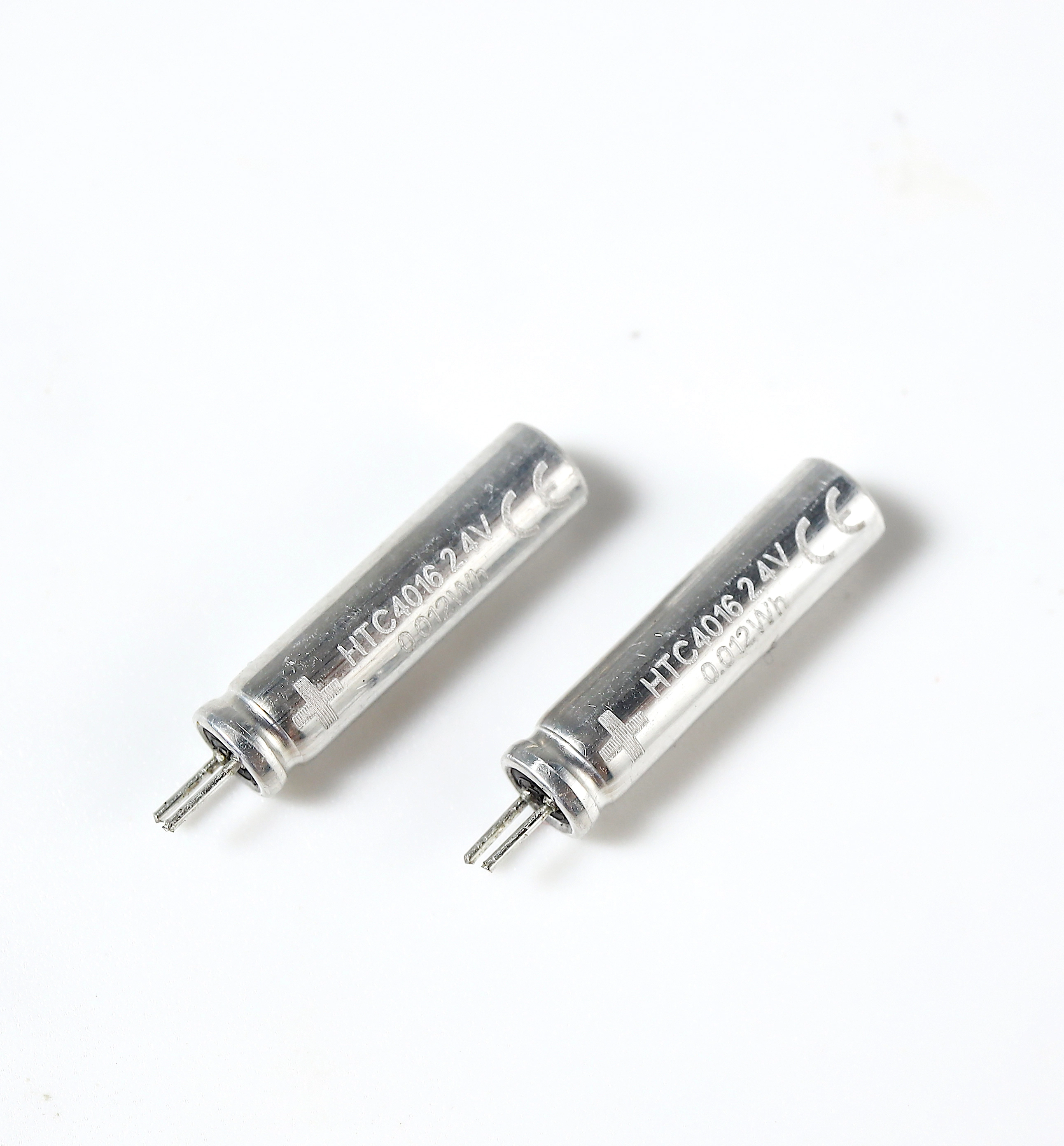
HTC4016 lto battery for Meat probe and stylus
HTC4016 Super capacitive lithium titanate battery:
● Huahui Energy HTC series batteries are high rate lithium titanate batteries. HTC means High rate Titanate Cell.
Battery size:
● 4mm diameter, 16mm height.
Battery applications:
● Meat probe, Stylus pen, Portable wearable devices and Equipment used in extreme high temperatures
|
Item |
General Parameter |
Remark |
|
|
Rated Capacity |
Typical |
5mAh |
Standard discharge after |
|
Minimum |
4.5mAh |
||
|
Nominal Voltage |
2.4V |
Mean Operation Voltage |
|
|
Internal Impedance |
≤1.5Ω |
Charged to about 70%ofcapacity |
|
|
Standard charge |
Constant Current 5 mA |
Charge time:Approx 1.5h |
|
|
Standard discharge |
Constant current 5mA |
|
|
|
Fast charge |
Constant Current 50mA |
Charge time:Approx 0.2h |
|
|
Maximum Continuous |
50mA |
|
|
|
Operation Temperature Range |
Charge :0~40℃ |
60±25%R.H. |
|
|
Discharge :-30~85℃ |
|||
|
Storage Temperature Range |
Less than 1 year:-10~20℃ |
60±25%R.H. |
|
Application Advantages of HTC4016 Super Lithium-ion Battery in Meat Thermometer Probes, Stylus Pens and IoT Devices
I. Core Advantages for Meat Thermometer Probes
- Ultra-wide discharge temperature range for high-temperature cooking environments: The discharge operating temperature can reach -30~85℃. Since meat thermometer probes need to be used close to high-temperature areas such as ovens and baking trays, the battery can discharge normally within 85℃ without performance failure under high temperatures. It also works well in low-temperature environments, adapting to various cooking conditions.
- High vibration resistance to withstand slight vibration during use: It has passed professional vibration tests (30 minutes of vibration for each XYZ axis, variable frequency from 10-55Hz, amplitude of 1.6mm) with no leakage or ignition. Slight vibration occurs when the meat thermometer probe is picked up and inserted into food, and the battery can operate stably without failure risks.
- Miniaturized design for concealed installation without affecting use: With a diameter of only 4.0mm, a length of 16.2mm and a weight of merely 0.4±0.05g, the battery is ultra-compact and lightweight. It can be directly embedded in the slender rod of the meat thermometer probe without changing the probe's appearance and hand feel.
- High safety for food contact equipment: As a lithium titanate battery, it can withstand overcharging and overdischarging without risks and has passed stringent safety tests such as crush, short circuit, impact and forced discharge with no fire or explosion hazards. Since meat thermometer probes are food contact equipment, the high safety of the battery eliminates food safety risks caused by battery malfunctions. In addition, no extra Protection Circuit Module (PCM) is needed, saving the internal space of the probe rod.
II. Core Advantages for Stylus Pens
- Miniaturization + lightweight design for the slim structure of stylus pens: The compact size (4.0mm in diameter and 16.2mm in length) allows direct embedding in the stylus pen barrel without increasing the pen's thickness and weight, maintaining its portability and grip feel. The pin specification (¢0.4*3) is adapted to the narrow welding space inside the pen.
- Two charging modes (fast charge + standard charge) for flexible power supplement: It supports 1.0C standard charging (fully charged in about 1.5 hours) and 10C fast charging (fully charged in about 0.2 hours). Stylus pens are low-frequency use devices; if the battery runs out, the fast charge mode enables quick power supplement without long waiting, while the standard charge mode is suitable for daily slow charging to meet different usage habits.
- High impact/crush resistance to withstand stylus pen drops and crushes: It has passed the impact test with a 10kg weight dropped from a height of 1m and the crush test with a pressure of 13kN with no fire or explosion. Stylus pens are prone to drops and crushes in daily use, and the battery can withstand such accidents to avoid malfunctions.
- No PCM required, saving internal space of the pen: The lithium titanate battery itself can withstand overcharging and overdischarging without risks, so the PCM can be omitted, simplifying the internal structure of the stylus pen and reducing the overall weight. Moreover, it has simple welding requirements (soldering iron temperature of 320-350℃, welding time <3S), which is adapted to the miniaturized welding process of stylus pens.
- Low internal resistance for stable discharge: With an internal resistance of ≤1.2Ω (at 70% charge), the battery features stable discharge current. The touch control power supply of stylus pens has low-power and small-current requirements, and the stable discharge performance ensures touch sensitivity without stuttering or disconnection issues.
III. Core Advantages for IoT Devices
- Ultra-long cycle life to reduce equipment maintenance costs: Under 0.5C cycling, the battery can retain more than 70% of its initial capacity after over 3000 cycles. Most IoT devices are unattended outdoor/industrial equipment (e.g., temperature and humidity sensors, smart access control, wireless meter reading devices). The battery does not need frequent replacement under long-term charge-discharge cycles, greatly reducing the later maintenance costs of the equipment.
- Ultra-wide operating temperature range for multi-scenario deployment of IoT devices: With a discharge temperature range of -30~85℃ and a charging temperature range of 0~45℃, it can adapt to outdoor high and low temperature environments (e.g., -30℃ in northern winters and high outdoor temperatures in southern summers) and high-temperature industrial workshop environments for IoT devices. It solves the problem of performance failure of conventional lithium batteries under extreme temperatures and ensures the normal operation of equipment in harsh temperatures.
- Low power consumption compatibility + stable discharge capacity for long equipment standby time: With a nominal capacity of 5mAh (minimum 4.5mAh) and stable capacity under 0.5C discharge, the battery is suitable for the low-power intermittent operation of IoT devices (e.g., sensors collecting data at fixed intervals and wireless modules sending signals periodically). Its stable discharge performance ensures long standby time of the equipment, and the discharge capacity is guaranteed at different temperatures (still 60% at -20℃ and 95% at 60℃).
- Easy storage + long shelf life for the inventory and deployment cycle of IoT devices: It has flexible storage temperature requirements (-10~45℃ for storage less than 3 months, -10~20℃ for storage less than 1 year) and should be stored with 40%-70% charge. Recharging every 3~6 months can prevent overdischarging. The battery has a 1-year shelf life (counting from the shipment date). Since IoT devices may have a certain inventory cycle after production, the easy storage feature of the battery avoids performance degradation during inventory.
- High safety + no PCM required for the sealed/miniaturized design of IoT devices: It has passed all safety tests including short circuit, forced discharge, impact and crush, and no PCM is needed. Most IoT devices adopt a sealed and miniaturized design; omitting the PCM saves internal space, and the high safety prevents fires, explosions and other accidents caused by battery malfunctions in harsh outdoor environments, improving the overall reliability of the equipment.
- Excellent mechanical properties for the installation and transportation of IoT devices: It has no leakage or ignition in vibration tests, with low internal resistance and stable discharge. Vibration occurs during the transportation and installation of IoT devices, and the battery can operate stably without poor contact or performance degradation during long-term use, ensuring the continuous operation of the equipment.
General Advantages (Applicable to All Three Scenarios)
- Core lithium titanate features, high safety without PCM: Different from conventional lithium batteries, it can withstand overcharging and overdischarging without risks, and the PCM can be omitted, which not only saves the internal space of the equipment but also reduces the overall design and manufacturing costs of the equipment.
- Miniaturization + standardized welding for integration into small equipment: With its ultra-compact size, light weight, standardized pin specifications and welding requirements (320-350℃, <3S), the battery is easy to integrate into small equipment such as meat thermometer probes, stylus pens and IoT sensors. The simple welding process is suitable for large-scale production.
- Brand warranty for guaranteed quality: The battery has a 1-year warranty from the shipment date, and products with manufacturing defects caused by non-human abuse can be returned or replaced. This helps equipment manufacturers reduce supply chain risks and improve the overall quality control of products.
Huahui Energy has been established since 2009, and the capacitive lithium battery was invented by Huahui Energy. The capacitive lithium-ion batteries produced by Huahui Energy have the advantages of fast charging and high rate discharging just like supercapacitors.
Hunan Production Base: No. 8 Zizhu Road, Heshan District, Yiyang City
Copyright © 2026 www.huahuibattery.com | Sitemap | Privacy Policy